




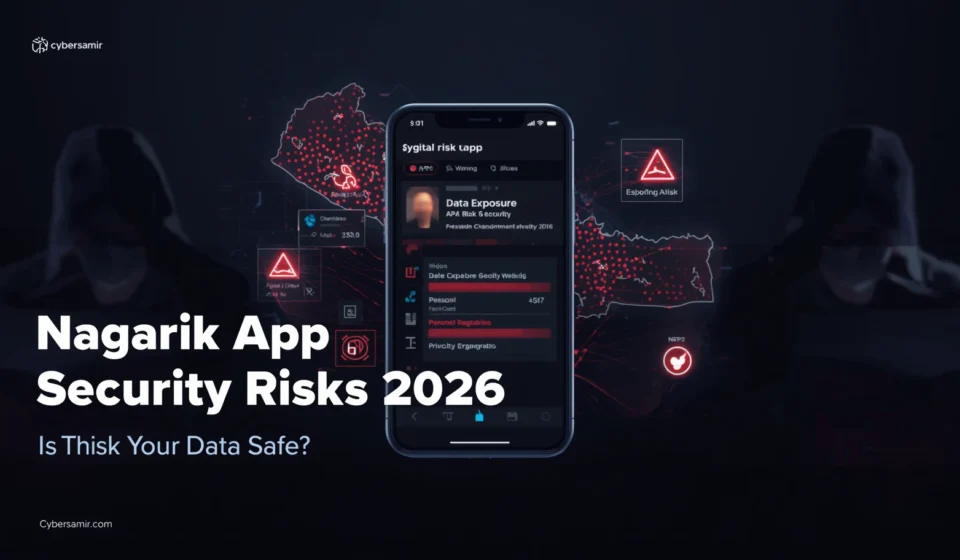

Your Data on Nagarik App Might Not Be Fully Safe Here’s Why? (2026 Analysis)
Imagine a single app on your phone that holds your citizenship certificate, National ID, PAN number, passport, driving license, land ownership records, and biometric-linked identity all verified and connected directly to government databases. Now imagine what happens if that app, or the infrastructure behind it, is compromised.
That is not a hypothetical scenario. That is the Nagarik App in 2026 and the question of Nagarik App security is one that deserves a serious, honest answer that goes beyond the government’s reassurances.
With over 55 million downloads and National ID integration now live, the Nagarik App has become Nepal’s most critical digital identity platform. It is the gateway to passport applications, bank account openings, tax payments, land records, and a growing list of private-sector services being integrated under new guidelines. More of Nepal’s essential civic life passes through this single app every month.
Security researchers have identified specific vulnerabilities in the app’s design. Nepal’s broader government infrastructure has suffered repeated, documented breaches in 2024 and 2025. The legal framework protecting citizen data remains outdated and inadequately enforced. And there is no mandatory public disclosure requirement when a government system is compromised.
In this analysis, we examine what data the Nagarik App actually holds, what security concerns have been raised by researchers, how Nepal’s recent cyber incident history creates context for those concerns, and what citizens and the government can do to reduce the risk.
This is not fear-mongering. It is an informed look at a real and growing risk one that every Nepali citizen using the app deserves to understand.
What is Nagarik App and What Data Does It Store?
The Nagarik App translated as “Citizen App” was launched by the Government of Nepal on January 15, 2021, developed by the Department of Information Technology under the Ministry of Communication and Information Technology. The vision was straightforward: one platform, all government services, accessible from your phone without visiting offices.
In practice, the app has evolved into Nepal’s primary digital identity infrastructure. Here is what it currently stores and connects:
- Citizenship Certificate: Number, issued date, district verified against Ministry of Home Affairs records
- National Identity Card (NID): Integrated since January 2025, allowing access to the National Identity Number (NIN) and biometric-linked identity data
- PAN Number: Tax registration details linked to the Inland Revenue Department
- Passport Information: Used for biometric passport applications; NIN is now mandatory for e-passport issuance
- Driving License: Verified digital copy, accepted by traffic police through QR scanning
- Land Records: Ownership documents and land maps integrated from the Department of Land Management
- Bank Account Details: Virtual account opening with Nepal Bank, Nepal Banijya Bank, and Sidhartha Bank through the app
- Local Government Tax Records: Payment and verification data
The authentication chain is built on your registered mobile number (SIM card in your name), an OTP, citizenship or National ID verification, and a four-digit PIN.
A major legal development occurred in October 2024 when the Cabinet approved the integration of the Nagarik App with the National Identity Card system. This integration means a single successful attack on the app’s infrastructure could theoretically expose not just one document, but the complete verified identity profile of every registered user.
That is the fundamental security concern with a platform of this design and it makes Nagarik App security a matter of national importance, not just individual user preference.
Why Centralized Apps Are High-Value Targets
The Nagarik App’s design is by necessity centralized. Every user’s identity data is aggregated, linked to government databases, and accessible through a single authentication system. This is what makes it convenient. It is also what makes it extraordinarily valuable to attackers.
In cybersecurity, this is called a single point of failure. When one system holds the keys to multiple identities, breaking that system means breaking access to all of them simultaneously.
Consider the scale: 55 million downloads in a country with a population of approximately 30 million means many citizens have registered with the platform. If the app’s backend systems were compromised in the way Nepal’s Ministry of Education or Nepal Police portal were compromised in 2025, the exposed data would not be a few thousand records it could be millions of citizen identity profiles, each containing citizenship numbers, National Identity Numbers, biometric linkages, tax records, and financial details.
That data has enormous downstream value. Attackers use leaked mobile numbers and citizenship details to social-engineer telecom customer service representatives, requesting SIM replacements. Once control of the number is obtained, SMS-based OTPs for banking, digital wallets, and government services become useless. In 2025, the Nepal Police Cyber Bureau recorded a 180 percent rise in SIM-swapping-related fraud cases directly linked to data leaks.
The more data points are centralized in a single app, the more devastating a breach becomes. This is the security trade-off at the heart of digital identity platforms and it requires a security standard proportional to the risk.
Latest Cybersecurity Incidents in Nepal: Why Context Matters
Nagarik App security cannot be evaluated in isolation. It exists within Nepal’s broader cybersecurity infrastructure and that infrastructure has faced serious, documented failures in 2024 and 2025.
January 2024: Government Data Centre DDoS Attack
In early 2024, Nepal’s main government server was hit by a massive Distributed Denial of Service (DDoS) attack. The attack overwhelmed the Government Integrated Data Center (GIDC), causing over 400 government websites including critical portals for immigration, passport services, and land administration to go offline for hours. Experts found that many of these portals lacked basic security measures like firewalls and rate-limiting features.
The Nagarik App’s backend connects to many of the same government databases that went offline in this attack. The incident demonstrated that Nepal’s central digital infrastructure is capable of being disrupted at scale by coordinated attacks.
Mid-2025: Ministry of Education 1.4 TB Breach
A staggering 1.4 terabytes of structured data, allegedly sourced from the ministry’s central student and staff database, surfaced on underground marketplaces. The dataset contained sensitive academic records, contact details, and citizenship numbers of students and faculty nationwide.
The same citizenship numbers that appear in that leaked dataset are the primary identifier used to register and verify Nagarik App accounts.
Late 2025: Nepal Police Portal 2 Million Records
Hacker collective “Kazu” publicly claimed responsibility for compromising the official police portal. Over 2 million records including citizenship certificates, passport scans, and biometric-linked data were exfiltrated and offered for sale on dark web forums. The data was offered for as little as $50 per batch.
The categories of data stolen from the Nepal Police portal citizenship certificates, passport scans, biometric-linked data are precisely the categories stored and verified in the Nagarik App. An attacker with this dataset could potentially use it to target Nagarik App users with highly credible, personalized phishing attacks.
Early 2025: Ministry of Federal Affairs Compromise by FunkSec
FunkSec advertised access to the super admin panels of four government websites, including the Nepal Ministry’s portal. These panels reportedly oversee sensitive information such as budgetary details, municipal records, and official directives. A ministry spokesperson confirmed they were unaware of the breach a concerning pattern of government departments learning about their own compromises from external sources.
The Pattern Behind the Incidents
This breach follows a pattern of cyber attacks on Nepali institutions. Earlier breaches, such as the 2020 Vianet Communications hack exposing 160,000 customers’ data, underscore systemic weaknesses in Nepal’s cybersecurity defenses. The NCSC issued a 102-point advisory in January 2025 mandating regular software updates, multi-factor authentication, and network segmentation but compliance remains inconsistent.
The critical question for Nagarik App security is this: if these government systems were breached with inadequate detection and disclosure, what guarantee exists that the Nagarik App’s backend which connects to many of the same government databases meets a meaningfully higher security standard?
Potential Security Risks in Nagarik App
Based on publicly documented vulnerabilities and the structural realities of the platform, here are the security risks users and security researchers have identified. These are presented as analytical concerns, not confirmed active exploits.
Reported PIN Bypass Vulnerability
Security researchers have identified a serious flaw that allows unauthorized access to sensitive sections by pressing the back or exit button. If confirmed and unpatched, this would represent a critical authentication control failure meaning physical access to an unlocked device running the Nagarik App could be sufficient to bypass the PIN protection and access sensitive documents.
This type of vulnerability where application state transitions do not properly enforce authentication is a known class of mobile app security failure documented in the OWASP Mobile Application Security standard.
Inconsistent Screenshot and Screen-Sharing Controls
Unlike other sections, the PAN page permits screenshots and screen sharing, creating inconsistent security protocols. This inconsistency suggests that security controls were applied selectively during development rather than enforced as a platform-wide standard. In a screen-sharing attack where malware or a socially engineered screen-share grants an attacker visibility into a victim’s device inconsistent screenshot restrictions mean that some of the most sensitive data remains exposed.
Centralized Database Exposure Risk
The Nagarik App functions as a gateway to multiple government databases. Any API security misconfiguration, broken access control, or session management flaw in the app or its backend could potentially expose data not just for the requesting user, but for other users if requests are not properly isolated and validated.
The kinds of API misconfigurations responsible for many high-profile global breaches including insecure direct object references, improper token validation, and overly permissive API responses are not hypothetical risks in government-built applications. They are among the most commonly found vulnerabilities in apps developed under time pressure without dedicated security engineering.
OTP-Based Authentication as a Single Dependency
The Nagarik App’s registration and primary authentication flow depends on OTP delivered via SMS to the registered SIM card. In 2025, Nepal Police Cyber Bureau recorded a 180 percent rise in SIM-swapping-related fraud cases directly linked to data leak Nepal incidents.
A successful SIM swap on a victim’s number gives an attacker the ability to receive the OTP for Nagarik App account registration on a new device effectively allowing them to claim the victim’s digital identity.
Third-Party Integration Risk
The new Nagarik App (Operation and Management) Guideline, 2082 now allows private companies to integrate with the app after technical committee approval. The guideline enables private companies offering public-oriented services to be integrated into the Nagarik App. Each additional integration point is an additional attack surface. The security practices of third-party integrations are only as strong as the least secure partner in the chain.
Social Engineering Amplified by Centralized Data
If data from the Nepal Police breach or Ministry of Education breach is used by attackers to craft targeted phishing messages referencing victims’ citizenship numbers or NINs the legitimacy of those messages becomes extraordinarily convincing. “Your Nagarik App account linked to citizenship number 12-34-5678 requires verification” is a message most people would not immediately recognize as fraudulent.
Critical Vulnerability Analysis
Let us be clear about the analytical framework: the vulnerabilities described below are structural risks associated with apps of this type. We are not claiming confirmed active exploitation of Nagarik App systems. We are applying standard cybersecurity risk analysis to what is publicly known.

| Vulnerability Class | Risk Level | What It Could Enable | Status |
|---|---|---|---|
| PIN/authentication bypass (reported) | Critical | Unauthorized device access | Reported patch status unconfirmed |
| Inconsistent screenshot controls | High | Screen-sharing attack exposure | Documented inconsistency |
| API access control failures | High | Cross-user data exposure | Potential requires audit |
| OTP interception / SIM swap | Critical | Account takeover / identity theft | Active threat (180% SIM swap increase) |
| Third-party integration flaws | Medium–High | Data leakage via partner systems | Growing with new guideline |
| Social engineering with leaked data | High | Targeted phishing at scale | Active linked to 2025 breaches |
Why Nepal Is More Vulnerable
The risks above are not unique to Nepal. What makes them more dangerous here is the environment in which they exist.
Outdated Legal Framework: Nepal continues to rely on an outdated legal infrastructure to tackle cybercrime. The Electronic Transactions Act (ETA) of 2006 remains the foundational legal document a law conceived in a very different digital era. There is no mandatory breach disclosure requirement. Citizens may never know if their Nagarik App data has been compromised.
No Dedicated Data Protection Law: Nepal’s Individual Privacy Act, 2018 provides a foundation but lacks the enforcement mechanisms, breach notification requirements, and regulatory teeth of comprehensive data protection legislation like GDPR. The draft Cybersecurity Bill remains pending.
Under-Resourced Enforcement: The Cyber Bureau has only 106 personnel 28 IT experts handling 60 to 70 daily complaints. With a 1:650 investigator-to-complaint ratio, proactive security monitoring of government applications is effectively impossible at current capacity.
Low Digital Literacy: 62 percent of victims had no cybersecurity awareness training according to a 2024 Cyber Bureau survey. Users who do not understand OTP security, phishing recognition, or PIN protection are highly susceptible to the social engineering attacks that Nagarik App’s centralized data enables.
No Mandatory Security Audits: There is no publicly documented requirement for regular independent penetration testing of the Nagarik App. The app was initially launched in beta and described as a work in progress but a beta attitude toward security is inadequate for a platform now holding millions of citizens’ verified identity data.
Real Risk Scenario: What One Breach Could Mean
Imagine the following chain of events entirely plausible given Nepal’s current security landscape.
An attacker exploits an API misconfiguration in a newly integrated third-party service connected to the Nagarik App backend. They extract a database of 500,000 registered users names, citizenship numbers, NINs, registered mobile numbers, and partial financial details.
That data goes to a dark web marketplace. Fraud rings purchase it in batches. Each batch costs less than $100.
Within weeks, those fraud rings contact SIM providers impersonating victims, using the exact citizenship numbers and NINs from the breach to answer security questions. They successfully swap SIMs for thousands of targets. Those SIM swaps give them OTP access to banking apps, eSewa, Khalti, and crucially the ability to register fresh Nagarik App sessions on new devices using the victim’s identity.
The victim’s digital identity has now been duplicated. Under the victim’s name, the attacker can potentially open bank accounts, apply for loans, or access government services using the same verified credentials the victim built up over years.
There is no breach notification requirement. The victim may not know for weeks. By then, the fraud has already occurred.
This scenario is not invented. It is the direct combination of attack methods that are already documented as active in Nepal’s cybercrime environment SIM swapping, credential stuffing, and the exploitation of centralized identity data.
Is Nagarik App Safe? A Balanced View
The answer is: partially, and conditionally.
What the government has done right: The app uses OTP-based verification tied to registered SIM cards, connects to verified government databases rather than storing parallel copies of documents, and the new 2082 guideline includes a technical committee for reviewing private-sector integrations. Officials have stated that data is pulled only with user consent and that the system uses encryption.
Where significant gaps remain: The PIN bypass vulnerability reported by security researchers remains unaddressed in public documentation. There is no public bug bounty program encouraging responsible disclosure. Independent security audits, if conducted, are not published. The app’s security posture is only as strong as the weakest connected government system and Nepal’s government systems have demonstrated serious vulnerabilities repeatedly.
Most critically: there is no mandatory public disclosure if a breach occurs. Users have no mechanism to know whether their data has been compromised.
The Nagarik App is not unsafe by malicious design. It is an ambitious, genuinely useful platform built in a country where the security infrastructure, legal framework, and enforcement capacity have not kept pace with the digitization ambition. That gap is the risk.
Cybersecurity in Nepal is evolving, but government app security still faces challenges due to rapid digital adoption and lack of strict security testing.
How Users Can Protect Themselves
You cannot control the government’s security decisions. You can control your own exposure.
Treat your registered SIM as a security asset. The number you registered with Nagarik App is the master key. Contact your telecom provider and request a SIM lock or port-out PIN. This makes SIM swapping significantly harder.
Set a strong, unique PIN. Do not use birth year, phone number last digits, or any number guessable by someone who knows you. The four-digit PIN is your last line of defense if someone has physical access to your device.
Regularly close the app completely after use. Given the reported PIN bypass vulnerability involving the back button, closing the app fully not just navigating away reduces risk on a shared or briefly accessible device.
Enable your device’s biometric lock. Fingerprint or face authentication on the device level adds a layer of protection before an attacker even reaches the Nagarik App PIN.
Never share your OTP. No government official, bank representative, or app support agent has any legitimate reason to request your OTP. If you receive a call asking for it in connection with your Nagarik App it is a scam.
Audit which services are linked. Review the integrations you have approved in the Nagarik App. Remove connections to services you no longer use.
Monitor your bank accounts and digital wallets. Given the connection between Nagarik App identity and banking services, any unusual financial activity should trigger immediate follow-up. Enable real-time transaction SMS alerts on all linked accounts.
Report suspicious activity. Contact Nepal Police Cyber Bureau at 01-4416060 or through their online complaint portal if you suspect your identity has been misused.
What the Government Must Improve
The Nagarik App’s ambitions are right. The security standards surrounding them need urgent elevation.
Commission and publish independent security audits. Regular penetration testing by credible third-party security firms with published findings and remediation timelines is the minimum acceptable standard for an app holding the identity data of millions of citizens.
Launch a bug bounty program. Nepal’s growing community of ethical hackers and security researchers can find vulnerabilities before malicious actors do but only if there is a formal, safe channel for reporting them. A structured bug bounty program would cost a fraction of what a single major breach would.
Enact mandatory breach notification. Citizens whose data is compromised have a right to know. Mandatory breach notification within 72 hours of confirmed compromise, as GDPR requires should be written into Nepal’s Cybersecurity Bill as a non-negotiable provision.
Patch publicly reported vulnerabilities with documented timelines. The PIN bypass vulnerability reported by security researchers should have a public patch status, a confirmed timeline, and verification that it has been resolved. Silence is not reassurance.
Extend two-step authentication options. OTP-only authentication is vulnerable to SIM swapping. Offering app-based authentication (TOTP) as an alternative gives users a meaningfully stronger option for protecting their Nagarik App accounts.
Enforce security standards on third-party integrations. The new guideline allowing private-sector integration is a positive development for service expansion but each integration must be subject to documented security requirements, regular re-audit, and rapid removal procedures if vulnerabilities are discovered.
CyberSamir Expert Insight
The Nagarik App is one of the most important digital infrastructure projects Nepal has built — and exactly because it matters so much, its security standards must be held to a correspondingly high level.
What concerns us most is not any single reported vulnerability. It is the pattern. Nepal’s government systems have been compromised repeatedly in 2024 and 2025, and in most cases, the affected departments were not even aware until researchers or journalists reported it externally. A government that learns about its own data breaches from dark web listings is not a government with adequate security monitoring.
For Nagarik App to be genuinely trustworthy, Nepal needs three things it currently lacks: mandatory independent security audits with public results, a structured channel for ethical hackers to report vulnerabilities safely, and a legal requirement to notify citizens when their data is compromised.
Until those are in place, the honest answer to “Is Nagarik App safe?” is: it is safer than carrying physical documents in an insecure environment, and less safe than it should be given what it holds.
Use it thoughtfully. Protect your SIM card. Protect your PIN. And hold the government accountable for building security infrastructure proportional to the responsibility it has taken on.
Key Takeaways
- Nagarik App security matters at national scale with 55 million downloads and National ID integration, a single breach could expose millions of citizens’ complete verified identity profiles.
- Security researchers have documented a PIN bypass vulnerability allowing unauthorized access via the back button, and inconsistent screenshot controls that leave the PAN page unprotected.
- Nepal’s government infrastructure suffered serious documented breaches in 2024–2025: the GIDC DDoS attack (400+ sites), Ministry of Education 1.4 TB dump, Nepal Police portal (2 million records), and Ministry of Federal Affairs compromise.
- SIM-swapping attacks which directly target OTP-based authentication like Nagarik App uses increased 180% in 2025 following data leaks of citizenship numbers and mobile details.
- Nepal has no mandatory breach notification requirement, no published independent security audit of the Nagarik App, and no formal bug bounty program.
- The Electronic Transactions Act (ETA) of 2006 provides the primary legal framework for digital security and it predates social media, cryptocurrency, biometric identity systems, and AI-driven fraud.
- Users can reduce their risk by setting a SIM lock, using a strong PIN, closing the app fully after use, and enabling real-time transaction alerts on all linked financial accounts.
- Nepal needs mandatory independent security audits, a bug bounty program, mandatory breach notification, and stronger authentication options to bring Nagarik App security to a standard proportional to what it holds.
Conclusion
The Nagarik App is a genuine achievement in Nepal’s digital transformation journey. In a country where obtaining government services once required multiple in-person visits, forms in triplicate, and days of travel for citizens in remote areas, a single verified digital platform represents real progress.
But progress and security are not the same thing. And the question of Nagarik App security demands honest scrutiny precisely because the app’s importance is so high.
Nepal has experienced repeated, documented breaches of government systems in 2024 and 2025. Security researchers have identified specific vulnerabilities in the app’s authentication design. The legal framework protecting citizen data is outdated and lacks enforcement teeth. And there is no mandatory requirement to tell you if your data has been compromised.
That is the reality that every Nagarik App user should understand not to abandon the platform, but to engage with it thoughtfully, advocate for the security standards it deserves, and take the practical steps available to reduce their personal exposure.
Responsible digital governance means building platforms that are not just convenient but trustworthy. The Nagarik App can be both. Getting there requires the government to treat security not as a feature to add eventually, but as a foundational requirement that existed from day one.
Nepal’s citizens have entrusted the government with their most sensitive identity data. That trust deserves to be honored with security standards that match the weight of the responsibility.
Internal Linking :
For official information and updates, users should always refer to the Nagarik App provided by the Government of Nepal.
As highlighted by global cybersecurity standards, protecting digital identity requires strong security practices, as explained by organizations like the OWASP.
With rising cybercrime incidents, users should stay informed through trusted sources such as the Nepal Police Cyber Bureau.