






Cybersecurity Career in India: Complete Roadmap for Beginners (2026 Guide)
Every year, thousands of engineering and BCA students in India reach their second or third year and hit the same wall: “I do not want to do a generic software job, but I do not know what else to do with an IT degree.”
Meanwhile, India is facing one of the most severe cybersecurity talent shortages in the world. As of 2025, there are over 40,000 unfilled cybersecurity positions in India and that number is growing faster than colleges are producing qualified graduates. Companies are hiring, salaries are rising, and the barrier to entry is lower than most people think.
A cybersecurity career in India is not reserved for IIT graduates or people with ten years of coding experience. It is one of the few fields where consistent self-learning, the right certifications, and hands-on practice can genuinely outweigh a traditional academic pedigree.
In this guide, you will get a complete, honest, step-by-step roadmap for starting a cybersecurity career in India in 2026. We will cover which skills to learn first, which certifications actually matter, what salaries look like at each level, which job roles to target, and the most common mistakes beginners make that slow everything down.
Whether you are a student, a recent graduate, or someone switching careers from another IT field this is the guide you needed someone to give you earlier.
What is Cybersecurity?
Cybersecurity is the practice of protecting computers, networks, applications, and data from unauthorized access, damage, or theft.
Every time you log into your bank app, every time a hospital stores patient records, every time a government system processes a tax filing there is cybersecurity infrastructure working in the background to keep that data safe and accessible only to the right people.
As more of the world’s critical functions move online banking, healthcare, elections, infrastructure the stakes around protecting those systems rise proportionally. A breach at a major Indian bank is not just a technology problem. It is a national security problem.
Cybersecurity professionals are the people who find vulnerabilities before attackers do, build defenses that hold under pressure, respond to incidents when breaches happen, and train organizations to develop safer habits. It is one of the most diverse, intellectually challenging, and financially rewarding fields in modern technology.
Why Choose a Cybersecurity Career in India?
Let us be direct about why this field makes sense specifically for Indian learners in 2026.
Demand is far ahead of supply. India’s digital infrastructure has expanded explosively through UPI, DigiLocker, ONDC, and government digitization programs. Each new system requires security expertise. Hiring demand consistently outpaces the availability of qualified candidates.
Salaries are competitive and growing fast. A fresher with the right skills and certifications can earn ₹4–6 LPA to start. Mid-level professionals with 3–5 years of experience command ₹12–25 LPA. Experienced security architects and red team leads earn ₹30–60 LPA and above. These numbers have risen steadily year over year.
Remote and global opportunities are real. Many cybersecurity roles especially penetration testing, bug bounty hunting, and security research can be done remotely. Indian professionals regularly work for US, UK, and European firms at international salary rates while living in India.
Bug bounty provides an income path without a job. Platforms like HackerOne and Bugcrowd pay independent researchers for finding vulnerabilities. Indian researchers consistently rank among the top earners globally. This is a path that can generate income even as a student, with no employer required.
The field rewards skill over pedigree. A self-taught student from Nagpur who has strong practical skills, a solid bug bounty track record, and one or two good certifications is a more attractive candidate than someone with a generic degree and no hands-on experience. This is one of the few fields in India where that is genuinely true.
Cybersecurity Career Roadmap: Step by Step (Core Section)
Here is the honest, practical sequence. Skipping steps is the most common reason beginners stall out. Work through each stage before moving to the next.
Stage 1: Build Your IT Foundation (1–3 Months)
Before cybersecurity makes sense, you need to understand what you are protecting.
Start with networking basics. Learn how the internet actually works: IP addresses, DNS, HTTP/HTTPS, TCP/IP, ports, routing. You do not need to become a network engineer but you need to be comfortable reading a network packet and understanding what it means.
Then learn Linux fundamentals. Most cybersecurity tools run on Linux. Get comfortable with the command line, file permissions, process management, and basic shell scripting. Ubuntu or Kali Linux on a virtual machine is a free starting point.
Understand how operating systems work at a basic level memory, processes, users and permissions, file systems. Windows internals matter for corporate security; Linux matters for servers and tools.
Resources: Professor Messer’s CompTIA A+ and Network+ videos (free on YouTube). Linux Journey (linuxjourney.com). TryHackMe’s “Pre-Security” learning path.
Stage 2: Learn Web Fundamentals (1–2 Months)
Web security is one of the most accessible and in-demand specializations. Before you can find web vulnerabilities, you need to understand how the web works.
Learn how HTTP works requests, responses, headers, cookies, sessions, status codes. Understand what happens between the moment you type a URL and the moment a page appears on your screen. This is not optional background knowledge — it is the foundation of 80% of what web security testers do daily.
Learn HTML and basic JavaScript not to become a developer, but to understand how web pages are constructed and how scripts run in a browser. Understanding the DOM and how JavaScript interacts with it is essential for understanding XSS and client-side vulnerabilities.
Understand APIs what they are, how REST APIs work, what JSON looks like, and how authentication tokens like JWTs function.
Resources: PortSwigger Web Security Academy’s “Web Application Basics” module (free). MDN Web Docs for HTML/HTTP references.
Stage 3: Learn Core Cybersecurity Concepts (2–3 Months)
Now you can start learning security concepts that will actually make sense because you have the foundation.
Study the OWASP Top 10 the ten most common and critical web application vulnerabilities. Understand each one: what it is, why it exists, how it is exploited, and how to prevent it. This list is the standard reference for web security worldwide.
Learn common attack types: SQL Injection, Cross-Site Scripting, IDOR, authentication bypass, CSRF, XXE, SSRF. Understand them conceptually first then practice finding them.
Study security concepts: the CIA triad (Confidentiality, Integrity, Availability), defense in depth, least privilege, authentication vs authorization, encryption basics.
Resources: PortSwigger Web Security Academy (free, comprehensive, hands-on). TryHackMe’s “Junior Penetration Tester” path.
Stage 4: Practice in Labs Consistently (Ongoing)
Reading about vulnerabilities is not enough. The gap between knowing and doing is where most beginners stall and consistent lab practice is how you close it.
PortSwigger Web Security Academy is the single best free resource for web security practice. Every topic comes with hands-on labs that simulate real vulnerabilities in controlled environments. Completing the full academy puts you ahead of many people with formal degrees in the field.
TryHackMe provides guided, gamified labs covering a broad range of topics from Linux basics to active directory attacks. Their learning paths are well-structured for beginners.
HackTheBox offers more challenging, realistic machines that are closer to actual penetration testing engagements. This is where you move after building confidence on TryHackMe.
Set a target of practicing at least 5–6 days per week. Consistency matters far more than intensity. An hour of focused daily practice beats a 10-hour weekend session followed by two weeks of nothing.
Stage 5: Build a Portfolio and Start Bug Bounty (3–6 Months In)
Once you have covered OWASP Top 10 and completed a solid portion of PortSwigger labs, you are ready to start looking for real vulnerabilities on real systems legally.
Bug bounty programs let you test companies’ systems with explicit permission, report vulnerabilities you find, and receive recognition and payment in return. Start with programs that have a broad scope, clear rules of engagement, and a beginner-friendly reputation. HackerOne and Bugcrowd both have public programs that accept new researchers.
Your first submission does not need to be a critical finding. A clear, well-documented report of a low or medium-severity vulnerability demonstrates that you can do the work professionally. Hall of Fame mentions from recognizable companies are powerful resume additions.
Build a write-up habit. Every time you solve a lab or find something interesting, write about it. A blog (even a free one on Medium or Blogger) that documents your learning, your lab solutions, and your bug bounty findings is a portfolio that speaks louder than any certificate in a job interview.
Stage 6: Apply for Jobs or Go Independent
With solid fundamentals, lab practice, a few bug bounty submissions, and a portfolio of write-ups, you are ready for the job market. Start applying for entry-level roles: SOC Analyst, Security Analyst, Junior Penetration Tester, or Vulnerability Assessment roles.
Use LinkedIn, Naukri, and company career pages. Follow security companies in India KPMG, Deloitte, PwC, Wipro Cybersecurity, Tata Communications, and dozens of specialized firms actively hire. Government organizations like CERT-In and DRDO also have security roles.
Skills Required for a Cybersecurity Career
No single person masters all of these, but these are the areas that matter most:
- Networking: TCP/IP, DNS, HTTP, firewalls, VPNs, packet analysis with Wireshark
- Linux: Command line fluency, permissions, scripting, log analysis
- Web Security: OWASP Top 10, HTTP, APIs, Burp Suite, browser dev tools
- Programming Basics: Python for automation and scripting, JavaScript for understanding client-side attacks, SQL for understanding injection vulnerabilities
- Analytical Thinking: The ability to approach a system as a potential attacker and reason about where assumptions might break
Top Cybersecurity Job Roles in India
Security Analyst
Monitors systems and networks for threats, investigates alerts, and responds to incidents. This is one of the most common entry-level roles, often in a Security Operations Center (SOC). Good starting point for beginners.
SOC Analyst (Tier 1 / Tier 2)
Works in shifts monitoring real-time security events using SIEM tools like Splunk or IBM QRadar. Tier 1 handles alert triage; Tier 2 investigates deeper. High demand, many openings for freshers with CompTIA Security+ or equivalent knowledge.
Penetration Tester
Hired to ethically attack systems and find vulnerabilities before real attackers do. Requires strong technical skills and practical experience. Usually not an entry-level role most pentesters come in with 1–3 years of prior security experience or strong bug bounty credentials.
Bug Bounty Hunter
An independent researcher who finds vulnerabilities in company systems through authorized programs and receives payment for valid reports. Can be a part-time income stream or a full-time career. Income is variable but top Indian hunters earn tens of lakhs annually.
Security Engineer
Builds and maintains security infrastructure: firewalls, WAFs, SIEM systems, IAM solutions, security automation. Typically requires broader IT engineering experience alongside security knowledge.
Application Security (AppSec) Engineer
Works directly with development teams to find and fix security issues in code before it ships. Increasingly in demand as software companies recognize that security cannot be bolted on after launch. Knowledge of secure coding practices and code review is essential.
Certifications: Which Ones Actually Matter
Certifications signal to employers that you have validated knowledge. Here is an honest guide to which ones are worth your time and money at each stage.
Starting Out: CompTIA Security+
The most widely recognized entry-level security certification globally. Validates foundational knowledge across a broad range of security topics. Accepted by government and enterprise employers alike. Cost: approximately ₹25,000–35,000 for the exam. Worth it early in your career.
For Ethical Hacking: CEH (Certified Ethical Hacker)
The EC-Council’s CEH is well-recognized in India and commonly listed in job postings. It covers offensive security concepts and tools. It is more theoretical than practical but carries name recognition in the Indian job market. Cost: ₹40,000–70,000.
For Serious Pentesters: OSCP (Offensive Security Certified Professional)
The gold standard for penetration testing credentials. Entirely practical — you must hack into real machines in a 24-hour exam. Demanded by serious security firms globally. Expensive (around ₹90,000–1,20,000 including lab time) and challenging, but enormously respected. Aim for this after 1–2 years of experience.
Free / Low-Cost Starting Points
Google’s Cybersecurity Certificate on Coursera and Microsoft’s SC-900 certification are affordable ways to build foundational knowledge and demonstrate initiative before committing to expensive exams.
Cybersecurity Salary in India: Realistic Numbers for 2026

| Experience Level | Role Examples | Salary Range (Per Annum) |
|---|---|---|
| Fresher (0–1 year) | SOC Analyst, Security Analyst | ₹3.5 – 6 LPA |
| Junior (1–3 years) | Penetration Tester, AppSec Analyst | ₹6 – 14 LPA |
| Mid-Level (3–6 years) | Senior Pentester, Security Engineer | ₹14 – 28 LPA |
| Senior (6+ years) | Security Architect, Red Team Lead | ₹28 – 60 LPA |
| Bug Bounty (variable) | Independent Researcher | ₹0 – ₹50+ LPA (skill-dependent) |
These are realistic ranges for Indian market roles. Companies like FAANG, international consulting firms, and product companies at the higher end of the range often offer additional stock options and benefits that push total compensation significantly higher.
Degree vs Skills: The Honest Answer
This is one of the most debated questions in Indian cybersecurity communities, and the answer is more nuanced than either camp admits.
A degree helps but it is not the gate. A B.Tech or BCA in Computer Science gives you structured learning, a campus placement network, and foundational knowledge. If you are currently enrolled, finish it. The credential still opens doors in traditional enterprises and government roles.
Skills and certifications are what get you hired. Interview processes at reputable security firms test practical ability, not transcripts. A candidate with strong PortSwigger lab completion, a few bug bounty Hall of Fame credits, an OSCP or Security+ certification, and clear write-ups on a blog will be more attractive than someone with a generic degree and no hands-on experience.
The realistic path for most beginners: Use your degree years to simultaneously build practical skills. Your degree finishes the institutional requirement; your portfolio demonstrates actual capability. The combination is more powerful than either alone.
Self-learning is entirely viable as a primary path if you are disciplined, consistent, and strategic about building demonstrable proof of your skills.
Best Resources to Learn Cybersecurity in India
Practice Platforms (Most Important)
- PortSwigger Web Security Academy — Free, comprehensive, practical. The best single resource for web security.
- TryHackMe — Beginner-friendly, gamified, guided paths. Start here.
- HackTheBox — More challenging, closer to real engagements. Move here after TryHackMe.
YouTube Channels
- NetworkChuck: Engaging, beginner-friendly networking and Linux content
- John Hammond: CTF walkthroughs and security concepts
- David Bombal: Networking deep dives
Communities and Practice
- HackerOne Hacktivity Read disclosed bug reports to understand real vulnerabilities
- Reddit r/netsec and r/bugbounty Active communities with resources and discussion
- CTF competitions PicoCTF (beginner-friendly), CTFtime.org lists upcoming events
Blogs and Write-Ups
- PortSwigger Research Blog
- HackerOne disclosed reports
- Personally, writing your own blog as you learn the best retention tool there is
Common Mistakes Beginners Make (And How to Avoid Them)
Skipping networking and Linux basics. Every advanced topic in cybersecurity builds on these foundations. Skipping them to jump straight to “hacking” creates knowledge gaps that show up painfully in practical scenarios and interviews.
Watching too many videos without practicing. Passive consumption feels like learning. It is not. You can watch every Burp Suite tutorial on YouTube and still be unable to use the tool without guidance. Practice in labs every single day.
Trying to learn everything at once. Cybersecurity has enormous breadth web security, network security, malware analysis, cloud security, reverse engineering. Beginners who try to learn all of it learn none of it deeply. Pick one specialization and go deep before expanding.
Not documenting their work. Every solved lab, every bug found, every concept understood should be written down. This documentation becomes your portfolio. Interviewers will ask you to walk them through something you found. “I solved a lot of labs” is not an answer. A blog post with screenshots and methodology is.
Waiting until they feel “ready” to apply. There is no moment when you suddenly feel ready. Apply early. The interview process teaches you what you still need to learn, which is itself valuable learning. Most people get their first security job before they feel ready for it.
Learning Path Comparison Table
| Path | Time to Job-Ready | Approximate Cost | Outcome |
|---|---|---|---|
| Self-Learning + Bug Bounty + CompTIA Security+ | 12–18 months | ₹30,000–50,000 | Entry-level analyst / junior pentester |
| Degree + Security certifications + Lab practice | 3–4 years | ₹3,00,000–8,00,000 | Stronger placement network, enterprise roles |
| Intensive bootcamp (online/offline) | 6–12 months | ₹50,000–2,00,000 | Variable — depends heavily on program quality |
| OSCP-focused path (experience required) | 2–3 years total | ₹1,50,000–2,50,000 | Mid-to-senior pentester roles |
| Bug Bounty only | 18–36 months | Near zero | Independent income, no traditional job required |
CyberSamir Expert Tip
The single biggest career accelerator for Indian cybersecurity beginners is not a certification it is a public track record.
Here is what that means in practice. Create a free account on HackerOne. Submit your first bug bounty report even if it is low severity. Get on at least one company’s Hall of Fame. Write a blog post about a PortSwigger lab you found interesting. Document a CTF challenge you solved. Put all of this on a GitHub profile or a simple personal website.
When you sit in an interview and the interviewer asks “What have you actually done?” you have an answer with links. That is more convincing than any certificate on a wall.
Most Indian cybersecurity beginners spend 6–12 months learning privately, then try to enter the job market with no public evidence of their skills. The ones who build in public even imperfectly, even at a beginner level get noticed significantly faster.
Start building your public track record on day one, not after you feel ready. Your first write-up does not need to be impressive. It needs to exist.
Key Takeaways
- A cybersecurity career in India is one of the most accessible high-paying career paths available in 2026 demand far exceeds supply.
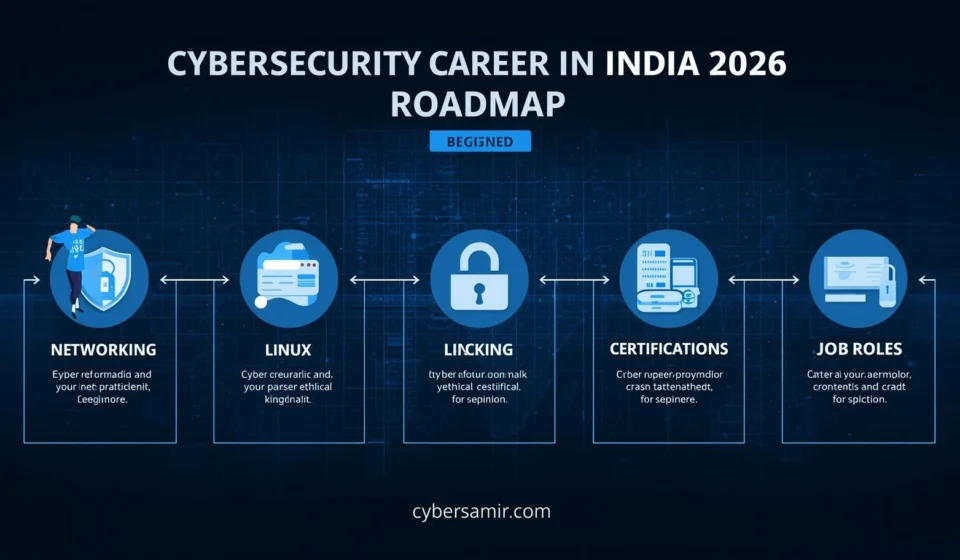
- The roadmap is clear: IT foundations → web fundamentals → security concepts → lab practice → bug bounty → job applications.
- Consistency in lab practice beats bursts of intense study. Aim for daily practice over marathon sessions.
- PortSwigger Web Security Academy and TryHackMe are the two most valuable free learning resources for beginners.
- CompTIA Security+ is the right first certification for most beginners. OSCP is the goal for serious pentesters.
- Fresher salaries range from ₹3.5–6 LPA; mid-level roles reach ₹14–28 LPA; senior professionals earn ₹28–60+ LPA.
- A degree helps but is not mandatory skills, certifications, and a demonstrable portfolio outweigh transcripts in hiring decisions.
- Public documentation of your work bug bounty submissions, lab write-ups, CTF solutions is the single most effective career accelerator.
- Do not wait until you feel ready to apply. Start applying, let the process teach you what you still need, and keep building.
Conclusion
A cybersecurity career in India is not some elite path reserved for the technically gifted or the formally educated. It is a field built for people who are genuinely curious about how things work and break, who are willing to practice consistently, and who are patient enough to build real skills rather than just collect certificates.
The roadmap is clear. The resources are largely free. The demand is real. The salaries are rising. The only thing standing between you and this career is time, consistency, and the decision to start.
India needs tens of thousands of cybersecurity professionals that it does not currently have. The organizations being attacked banks, hospitals, government systems, startups — need defenders. That is the work you could be doing.
Start with networking basics today. Open TryHackMe this evening. Read one OWASP vulnerability explanation before bed. Write one paragraph documenting what you learned.
One month of that habit, and you will be further along than most people who spent the same month thinking about starting.
To better understand global cybersecurity standards and best practices, beginners should explore the National Institute of Standards and Technology Cybersecurity Framework (NIST CSF). This framework is widely used by organizations worldwide and helps learners understand how real companies manage cyber risks, protect systems, detect threats, respond to incidents, and recover from attacks. Studying internationally recognized frameworks like NIST can strengthen your cybersecurity career in India and improve your professional credibility
Internal Linking:
Faq Section