






Nepal’s Capital Market Under Siege: What the Data Hub Ransomware Attack Really Means
What Happened
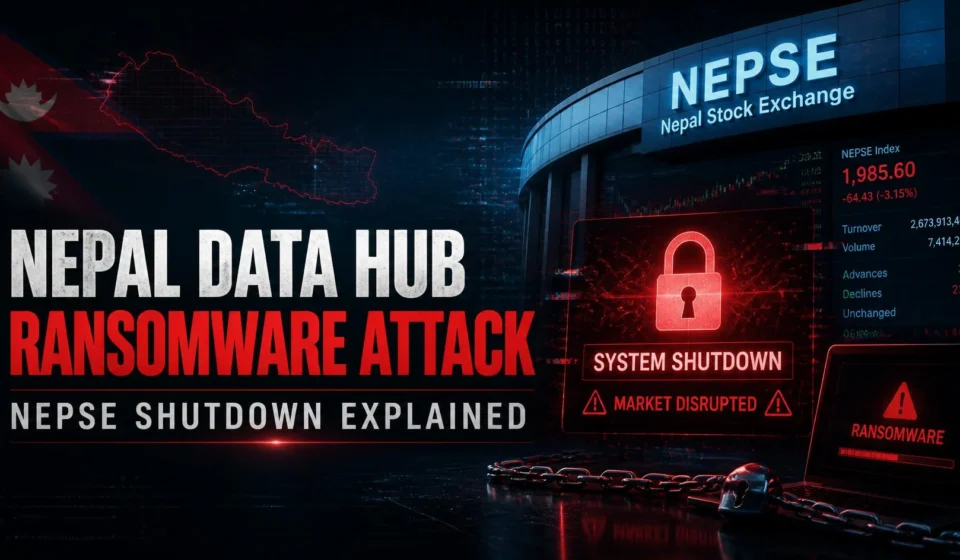
On the morning of September 20, 2026 (Ashwin 4, around 5:30 AM), a ransomware attack targeted the TMS hosting infrastructure of Data Hub Pvt. Ltd., a data center that hosts Trading Management System servers used by 72 brokerage companies registered under the Nepal Stock Exchange (NEPSE). Data Hub is located at Shikhar Biz Center in Thapathali and stores backups of the Trade Management Systems used by these 72 brokerage firms, with the TMS system itself built by YCO Pvt. Ltd.
The fallout was immediate and severe:
- The attack forced NEPSE to suspend all trading, effectively shutting down Nepal’s only stock exchange for the day.
- The breach affected 72 out of Nepal’s 92 registered stock brokerage firms, and the country’s capital market fully dependent on electronic systems had to shut down entirely.
- Most alarmingly, reports citing Nepali Paisa indicate the incident put the data of approximately 8 million investors at risk.
- SEBON (Securities Board of Nepal) responded by forming a five-member inspection committee led by an Executive Director to investigate root causes, review security protocols, and recommend preventative measures.
On the recovery side, there’s a genuine silver lining: Data Hub confirmed that all data up to 4:00 AM on September 20 roughly 90 minutes before the attack remained secure, because that backup had been isolated from the main network. That isolated-backup decision is likely why trading was able to resume as usual by Tuesday, September 22, after NEPSE confirmed the technical problem at Data Hub had been resolved.
Why This Attack Is More Dangerous Than It Looks
On the surface, a two-day trading suspension sounds like a manageable hiccup. But the structure of this attack is what should worry Nepal’s cybersecurity community:
1. Single point of failure for an entire national market. One data center hosting infrastructure for 72 of 92 brokerages means one breach can paralyze nearly 80% of a country’s stock trading capacity. This is a textbook example of concentrated third-party risk the kind of architecture that turns a routine IT incident into a systemic crisis.
2. Millions of investors, not just one company. Unlike a typical corporate ransomware case where the blast radius is one organization’s employees and customers, this incident potentially exposed data belonging to 8 million individual investors identity documents, trading histories, financial holdings, bank linkages. That’s a national-scale privacy exposure, not a business interruption.
3. It hit critical financial infrastructure. Stock exchanges, like power grids and hospitals, are considered critical infrastructure globally precisely because attacks on them cause cascading economic damage well beyond the ransom demand itself lost investor confidence, halted capital flows, and reputational damage to a country’s financial system as a whole.
4. It exposes a maturity gap. The fact that backups saved the day is good luck as much as good planning a difference of 90 minutes between “isolated, safe backup” and “compromised.” Many organizations don’t have that margin.
How This Compares to History’s Biggest Ransomware Attacks
To understand where the Data Hub incident sits on the danger spectrum, it helps to look at what ransomware has done elsewhere when the damage wasn’t contained quickly:

| Attack | Year | Sector | Estimated Impact |
|---|---|---|---|
| NotPetya | 2017 | Global (Ukraine-focused) | ~$10 billion in global losses the most financially destructive cyberattack to date, disguised as ransomware but functioning as a wiper |
| WannaCry | 2017 | Global (Windows systems) | 300,000+ computers infected across 150+ countries, roughly $4 billion in damage |
| Change Healthcare / UnitedHealth | 2024 | US Healthcare | Over $800 million in direct costs including a $22 million ransom, with total costs estimated at $2.5–3 billion; the largest healthcare breach in US history, affecting 100+ million people |
| Maersk (NotPetya victim) | 2017 | Global Shipping | 50,000 endpoints infected across 130 countries, a 10-day manual recovery, and roughly $300 million in losses |
| Costa Rica (government) | 2022 | National Government | 27 government institutions breached by the Conti gang, with ransom demands reaching $20 million |
| Colonial Pipeline | 2021 | US Fuel Infrastructure | $4.4 million ransom paid, roughly $2.3 million later recovered by the FBI, but triggered fuel shortages and panic buying across the US East Coast |
| CDK Global | 2024 | Auto Dealership Software | Cost North American auto dealerships more than $1 billion collectively |
| Data Hub (Nepal) | 2026 | Stock Market Infrastructure | 72 brokerages and ~8 million investors’ data at risk; NEPSE fully suspended; 2-day recovery |
What stands out in this comparison: Nepal got off comparatively light in terms of downtime and confirmed financial loss largely thanks to the isolated backup. But structurally, the Data Hub attack shares the exact pattern that made Costa Rica’s and Colonial Pipeline’s incidents so dangerous: a single, centralized service provider whose compromise cascades into a national-level shutdown. That’s the same category of vulnerability, just caught earlier in the blast sequence.
Had the attackers also compromised the isolated backup or had detection taken days instead of hours Nepal could easily be looking at a Costa Rica-style, multi-week recovery with far greater investor data exposure and economic disruption.
Lessons for Nepal’s Digital Infrastructure
- Diversify critical dependencies. Having 72 brokerages rely on one hosting provider is a single point of failure that needs redundancy geographically separated backups, multiple hosting providers, or failover systems.
- Backup isolation saved the day make it standard practice. Air-gapped or network-isolated backups should be non-negotiable for any organization handling financial or personal data at scale.
- Regular security audits and penetration testing. Financial infrastructure providers should undergo mandatory, independent security assessments not just after an incident, but continuously.
- Incident response plans need to be rehearsed, not just written. The speed of Nepal’s recovery (roughly 48 hours) suggests some preparedness existed; formalizing and stress-testing that response plan further would reduce the reliance on luck.
- Regulatory oversight with teeth. SEBON’s investigation is a good first step, but its recommendations need enforcement mechanisms, not just guidance similar to how financial regulators elsewhere mandate cybersecurity minimums for market infrastructure providers.
The Data Hub ransomware attack is Nepal’s clearest signal yet that its financial digital infrastructure is now a real target not a hypothetical one. It didn’t reach NotPetya or Change Healthcare-level devastation, but the ingredients for that kind of outcome were all present: centralized infrastructure, millions of exposed records, and a national market shut down by a single breach. The difference between what happened and what could happen next time may come down to exactly the kind of preparation isolated backups, redundancy, and rehearsed response that this incident is now forcing Nepal’s regulators and providers to take seriously.