




Nepal’s digital landscape has expanded rapidly, yet many websites remain dangerously exposed. In 2025 alone, high-profile incidents including the compromise of 21 Koshi Provincial Government subdomains in February, the Hello Sarkar portal in March, and the Nepal Police website in April highlighted systemic weaknesses that continue into 2026. These breaches not only disrupted services but also placed sensitive citizen data at risk, underscoring a persistent gap between Nepal’s digital ambitions and its cybersecurity maturity.
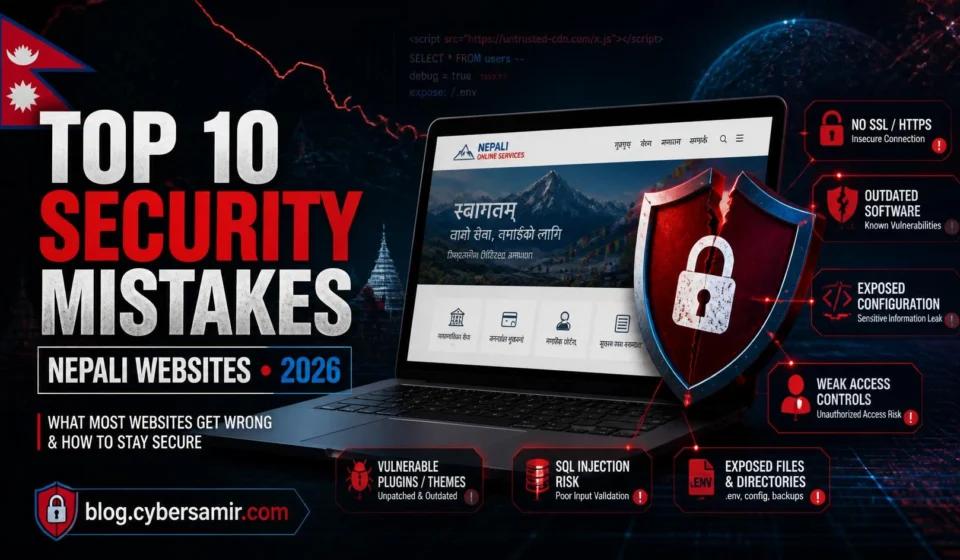
As a cybersecurity professional who has conducted vulnerability assessments for both private enterprises and public sector clients in Nepal, I have observed recurring patterns. The following ten security mistakes remain alarmingly common. Each section explains the issue, provides Nepal-specific context, outlines the consequences, and delivers clear remediation steps. Addressing these vulnerabilities is not optional it is essential for protecting user trust, regulatory compliance, and national digital infrastructure.
1. Relying on Outdated Content Management Systems and Plugins
Many Nepali websites, particularly small businesses and government portals, run on older versions of WordPress, Joomla, or custom CMS platforms without timely updates. Unpatched plugins and themes create exploitable entry points that attackers can scan and compromise within minutes.
In Nepal, shared hosting environments and budget-conscious developers often delay updates to avoid downtime. The result? Easy targets for automated bots. Recent incidents involving government sites have repeatedly traced back to known vulnerabilities in outdated components.
How to fix it: Schedule monthly updates, use automated tools where safe, and maintain a staging environment for testing. Remove unused plugins immediately.
Pro Tip: Enable automatic security updates for core files and consider managed WordPress hosting tailored for Nepali traffic patterns.
2. Failing to Implement Multi-Factor Authentication (MFA)
Weak or absent MFA remains a critical oversight. Default credentials or single-factor logins allow brute-force or credential-stuffing attacks to succeed with minimal effort.
Nepali startups and municipal websites frequently overlook MFA due to perceived complexity or user inconvenience. This mistake contributed to several 2025 administrative panel takeovers.
How to fix it: Enforce MFA across all administrative accounts, email systems, and hosting control panels. Use authenticator apps rather than SMS where possible.
Pro Tip: Combine MFA with role-based access control to limit damage even if one account is breached.
3. Using Weak or Reused Passwords
Password reuse across personal and professional accounts is widespread. Many sites still permit simple passwords or store credentials insecurely.
Local case studies reveal that attackers exploit reused credentials harvested from unrelated breaches to pivot into Nepali domains.
How to fix it: Mandate strong, unique passwords via policy and password managers. Implement account lockout mechanisms after failed login attempts.
Pro Tip: Adopt passkeys or biometric authentication for admin panels to eliminate password-related risks entirely.
4. Neglecting Regular Software Updates and Security Patching
Unpatched servers, libraries, and frameworks expose websites to known exploits. In Nepal’s cost-sensitive market, maintenance is often deprioritized.
The March 2025 DDoS attack that took down over 400 government websites exposed the fragility of centralized infrastructure lacking timely patches.
How to fix it: Establish a formal patch management schedule and monitor CVE databases relevant to your stack.
Pro Tip: Subscribe to Nepal-specific cybersecurity alerts and integrate vulnerability scanners into your development workflow.
5. Inadequate Input Validation Leading to SQL Injection and XSS
SQL injection and cross-site scripting (XSS) attacks dominate Nepali website compromises. Boolean-based SQLi, in particular, has proven highly effective against local sites because of poor sanitization practices.
Tourism portals, e-commerce stores, and even official directories have suffered data exfiltration through these classic injection flaws.
How to fix it: Use prepared statements, parameterized queries, and output encoding. Employ content security policy (CSP) headers to mitigate XSS.
Pro Tip: Conduct regular penetration testing focused on OWASP Top 10 risks, with special attention to injection vectors common in Nepali PHP/MySQL environments.
6. Improper or Missing HTTPS Implementation
Some sites still operate without valid SSL certificates or use self-signed ones. Others fail to enforce HTTPS redirection, exposing users to man-in-the-middle attacks.
With increasing mobile usage across Nepal, unsecured connections place citizen and customer data at immediate risk during transmission.
How to fix it: Obtain free certificates from Let’s Encrypt and configure HSTS headers. Redirect all HTTP traffic to HTTPS permanently.
Pro Tip: Monitor certificate expiry with automated alerts to prevent accidental outages.
7. Missing Essential Security Headers and Server Misconfiguration
Absence of headers such as X-Frame-Options, X-Content-Type-Options, and Referrer-Policy leaves sites vulnerable to clickjacking, MIME sniffing, and information leakage.
Nepali developers often focus on functionality over security, resulting in default server configurations that broadcast sensitive version information.
How to fix it: Add security headers via .htaccess (Apache) or nginx configuration files. Disable directory listing and server signature banners.
Pro Tip: Use online header scanners during every deployment to verify compliance.
8. Operating Without a Web Application Firewall (WAF)
Basic firewalls are frequently absent or improperly configured. Without a WAF, sites cannot filter malicious traffic before it reaches the application layer.
Shared hosting providers popular in Nepal rarely include enterprise-grade WAF protection by default, leaving small websites exposed to automated attacks.
How to fix it: Deploy a cloud-based WAF or enable ModSecurity rules on your server. Start with OWASP Core Rule Set.
Pro Tip: Choose a WAF provider with Nepal-optimized edge locations to minimize latency for local users.
9. Inadequate Backup and Disaster Recovery Planning
Many websites lack automated, off-site backups or have never tested restoration procedures. A single ransomware or defacement incident can result in permanent data loss.
Recent breaches involving government portals demonstrated how the absence of tested backups prolonged recovery times dramatically.
How to fix it: Implement the 3-2-1 backup rule (three copies, two media types, one off-site). Test restores quarterly.
Pro Tip: Store encrypted backups in geographically diverse locations, including cloud services compliant with Nepal’s data sovereignty considerations.
10. Insufficient Monitoring, Logging, and Incident Response
Without proper logging or real-time alerts, breaches go undetected for weeks. Most Nepali organizations remain reactive rather than proactive.
How to fix it: Enable comprehensive logging, integrate with a SIEM or simple monitoring tool, and develop a basic incident response playbook.
Pro Tip: Conduct tabletop exercises annually and maintain a relationship with Nepal Police Cyber Bureau for coordinated response.
Reference the latest OWASP Top 10:2025 for global best practices that directly apply to Nepali web applications.
FAQ Section
The top issues include outdated CMS platforms, lack of MFA, and SQL injection vulnerabilities caused by poor input validation. These errors continue to expose both private and government sites to frequent attacks.
Prioritize free tools such as Let’s Encrypt SSL, regular WordPress updates, a basic WAF, and strong password policies. Budget for annual professional vulnerability assessments.
Centralized hosting combined with outdated software and insufficient rate-limiting creates attractive targets for both local and international threat actors.
No. A WAF is an important layer of defense but must be combined with secure coding practices, regular updates, and proper authentication controls.
Perform automated scans monthly and full manual or professional penetration tests at least twice per year, or after any major update.
Immediately isolate the site, restore from a clean backup, change all passwords, enable MFA, and report the incident to Nepal Police Cyber Bureau while engaging a cybersecurity professional for forensic analysis.